
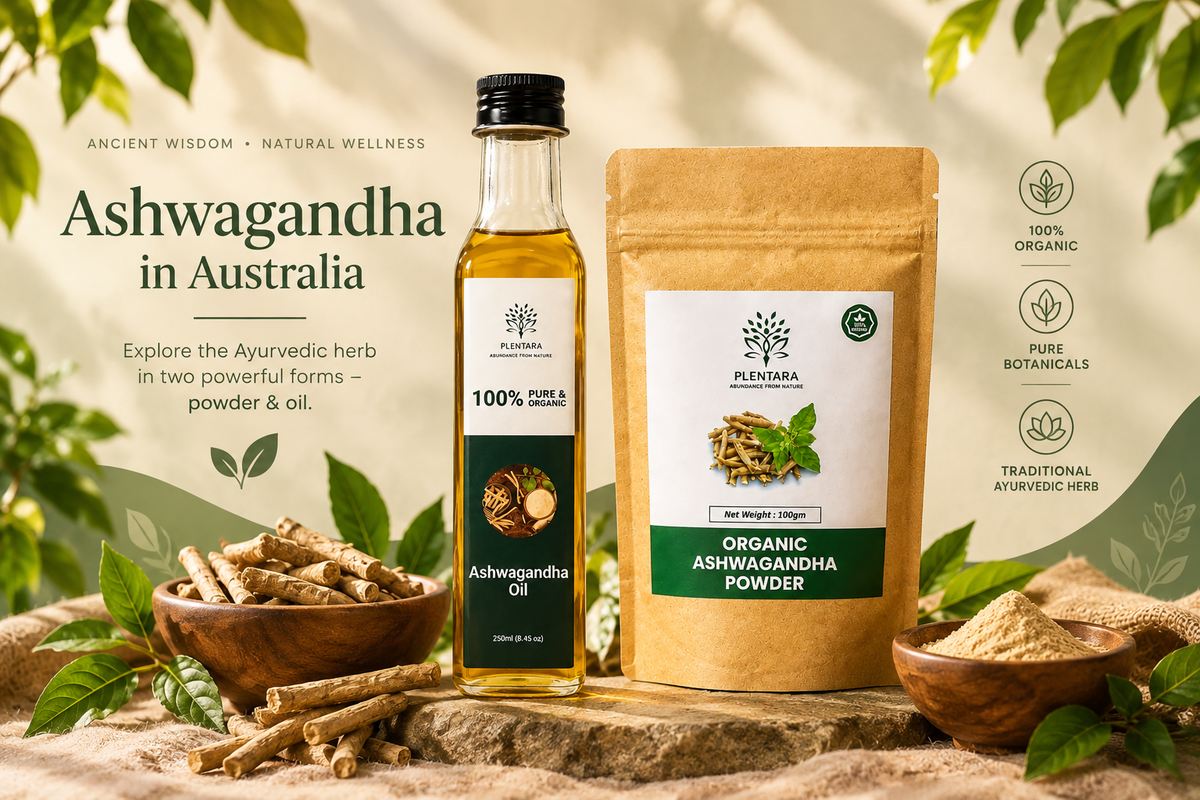
Ashwagandha in Australia: A Guide to the Ayurvedic Herb, Powder & Oil
Ashwagandha is one of the best-known herbs associated with Ayurveda. Also known botanically as Withania somnifera, the herb has a long history of traditional use in Indian wellness practices and is now widely recognised by people exploring botanical and Ayurvedic products in Australia.
Today, Ashwagandha is available in several forms, including powders, capsules, extracts and oils. Understanding the differences between these formats can help you choose a product that fits your preferences and intended routine.
At Plentara, Ashwagandha is available in two different formats: Organic Ashwagandha Powder and Organic Cold Pressed Ashwagandha Oil. The products are intended for different types of use, making it useful to understand what each format offers before choosing between them.
What Is Ashwagandha?
Ashwagandha is the common name for Withania somnifera, a botanical traditionally associated with Ayurveda.
It is sometimes referred to as Indian ginseng or winter cherry, although Ashwagandha is botanically different from true ginseng.
The plant has been used in traditional Ayurvedic practice for centuries, and its roots are particularly familiar in Ayurvedic preparations. The name Ashwagandha itself comes from Sanskrit and is traditionally associated with the characteristic aroma of the plant's root.
Modern interest in Ashwagandha has expanded well beyond traditional Ayurvedic settings. It is now commonly encountered in herbal powders, supplements, wellness products and botanical preparations.
However, products containing Ashwagandha are not all the same. The plant part used, preparation method, concentration and intended use can differ considerably between products.
Ashwagandha in Ayurveda
Ayurveda is a traditional system of Indian medicine with a history spanning thousands of years.
Within Ayurvedic traditions, Ashwagandha has been used as a botanical ingredient in a variety of preparations. Its traditional history is one of the reasons it remains popular among people interested in Ayurvedic herbs and traditional botanical practices.
It is important, however, to distinguish traditional use from modern medical claims.
A product being traditionally used for a particular purpose does not automatically mean that the same purpose has been clinically established for every modern Ashwagandha product.
For Australian consumers, looking at the actual product, ingredients, directions and intended purpose is therefore more useful than assuming all Ashwagandha products work in the same way.
Understanding Withania somnifera
When shopping for Ashwagandha, you may see the botanical name Withania somnifera on the product label.
Botanical names are useful because common names can sometimes vary between regions and products.
Plentara's Organic Ashwagandha Powder identifies Withania somnifera as its botanical ingredient and describes the product as a single-ingredient organic herbal powder. It is available in 100 g and 500 g sizes.
Understanding the botanical identity of a product is particularly useful when comparing herbal products online, because two products carrying the same common name may differ in their formulation or preparation.
Ashwagandha Powder
Ashwagandha powder is one of the more traditional formats for using the herb.
Unlike capsules, powder allows the ingredient to remain in a simple powdered format and can be incorporated into a preparation according to the product's directions.
Plentara's [Organic Ashwagandha Powder] is described as a 100% pure, single-ingredient organic herbal powder, with no fillers or artificial ingredients listed on the product page. It is available in 100 g and 500 g sizes.
The product page currently recommends mixing ½ teaspoon into warm milk, water, smoothies or herbal tea once daily, or using it as advised by an Ayurvedic practitioner or qualified health professional. Always follow the current product label and directions rather than relying solely on information in a blog article.
Why choose a powder format?
An Ashwagandha powder may appeal to people who:
- Prefer a traditional herbal preparation
- Want a single-ingredient powder
- Prefer to mix botanical powders into suitable drinks
- Want flexibility in how they incorporate the product
- Enjoy learning about traditional herbal preparations
The important point is to follow the instructions for the specific product you purchase.
Ashwagandha Oil
Ashwagandha is also available as an oil, providing a completely different format from powdered herb products.
Plentara's [Organic Cold Pressed Ashwagandha Oil] is listed as a 250 ml product and is described as a 100% organic cold-pressed Ashwagandha oil. The product page describes its use as either adding it to a diffuser or massaging it with a carrier oil.
Because an oil and a powder are different preparations, they should not be treated as interchangeable products.
The intended use, application method and directions can vary according to the formulation.
If you're specifically looking for an Ashwagandha product for topical or aromatic use, an oil format may be more relevant than a powdered herb.
Ashwagandha Powder vs Ashwagandha Oil
One of the easiest ways to understand the difference is to look at the format and intended use.
| Feature | Ashwagandha Powder | Ashwagandha Oil |
|---|---|---|
| Format | Herbal powder | Oil |
| Botanical ingredient | Withania somnifera | Ashwagandha |
| Product size | 100 g / 500 g | 250 ml |
| Preparation | Powdered herb | Cold-pressed oil |
| Product-page use | Mixed into suitable drinks/foods according to directions | Diffuser or massage with carrier oil |
| Best suited to | People interested in powdered herbal preparations | People interested in aromatic/topical oil use |
These are different product formats, not two versions that should simply be substituted for each other.
Always check the individual product label and directions before use.
How Is Ashwagandha Traditionally Used?
Ashwagandha has a long history within Ayurvedic traditions.
Traditional herbal preparations can vary depending on the preparation method, plant part and intended purpose.
Modern consumers may encounter Ashwagandha as:
- Powder
- Capsules
- Herbal extracts
- Oils
- Blended botanical formulations
This variety can make the category confusing for someone buying Ashwagandha for the first time.
Rather than choosing a product purely because it contains the word "Ashwagandha", look at the complete product information.
Consider:
- Botanical name
- Plant part used
- Product format
- Ingredients
- Recommended directions
- Serving or application information
- Warnings and precautions
- Manufacturer or retailer information
Why Are Australians Interested in Ashwagandha?
Interest in Ayurveda and traditional botanical ingredients has been growing within Australia's broader natural wellness market.
Ashwagandha is one of several Ayurvedic herbs that Australian consumers may encounter when exploring traditional Indian herbal practices. Plentara's existing guide to Ayurvedic supplements in Australia also identifies Ashwagandha alongside herbs such as amla, turmeric, tulsi, brahmi and arjuna.
For some shoppers, the appeal comes from the history of Ayurveda.
For others, it may simply be curiosity about botanical ingredients and traditional preparation methods.
Online shopping has also made it easier for Australian consumers to compare different herbal formats, ingredients and product information before purchasing.
What Should You Look For When Buying Ashwagandha in Australia?
If you're searching for Ashwagandha in Australia, don't stop at the product name.
1. Check the botanical name
Look for Withania somnifera where applicable.
2. Understand the format
Powder, oil, capsule and extract products can have very different characteristics.
3. Check the ingredient list
A single-ingredient powder is different from a multi-ingredient formulation.
4. Read the directions
The correct method of use depends on the individual product.
5. Check warnings and precautions
Herbal products aren't automatically suitable for everyone.
6. Buy from a transparent retailer
Clear ingredient information, directions and product details make it easier to make an informed decision.
Ashwagandha and Responsible Use
Ashwagandha has a long traditional history, but "natural" does not automatically mean risk-free.
This is particularly important in Australia because the Therapeutic Goods Administration has issued a safety alert regarding Withania somnifera. The TGA states that cases of liver injury associated with products containing Ashwagandha have been reported in Australia and internationally, with the risk considered very rare, but potentially serious.
The TGA also advises that people with existing or previous liver problems should avoid medicines and herbal supplements containing Withania somnifera.
Consumers should seek medical advice and stop using an orally consumed Withania somnifera product if symptoms such as yellowing of the skin or eyes, dark urine, nausea, vomiting, unusual tiredness, weakness, abdominal pain or loss of appetite occur.
This information is especially important when researching Ashwagandha online because products can differ significantly in formulation, concentration and intended use.
Always read the product label and follow its directions. If you are taking medicines, have an existing medical condition, are pregnant or breastfeeding, or have concerns about whether Ashwagandha is appropriate for you, speak with a qualified health professional before use.
Choosing Between Ashwagandha Powder and Oil
The best format depends on what you're actually looking for.
Choose a powder format if:
- You are interested in traditional powdered herbs
- You prefer a single-ingredient botanical powder
- You want a powder that can be prepared according to its product directions
- You prefer a traditional herbal format
Plentara's [Organic Ashwagandha Powder] is available in 100 g and 500 g sizes.
Consider an oil format if:
- You are specifically looking for an Ashwagandha oil
- You prefer an aromatic or topical format
- You want an oil suitable for the uses described by the manufacturer
Plentara's [Organic Cold Pressed Ashwagandha Oil] is available in a 250 ml format and its product page describes diffuser use and massage with a carrier oil.
Plentara Ashwagandha Products
If you're exploring Ashwagandha products in Australia, Plentara currently offers two different formats.
🌿 Organic Ashwagandha Powder
A single-ingredient organic Ashwagandha powder containing Withania somnifera, available in 100 g and 500 g sizes.
[Explore Plentara Organic Ashwagandha Powder →] Organic Ashwagandha Powder
🌱 Organic Cold Pressed Ashwagandha Oil
A 250 ml Ashwagandha oil listed by Plentara as organic and cold pressed, with product directions describing diffuser use or massage with a carrier oil.
[Explore Plentara Ashwagandha Oil →] Ashwagandha Oil
Frequently Asked Questions
What is Ashwagandha?
Ashwagandha is the common name for Withania somnifera, a botanical with a long history of traditional use in Ayurveda.
What is Ashwagandha powder?
Ashwagandha powder is a powdered herbal preparation made from Ashwagandha. Plentara's powder is described as a single-ingredient organic Withania somnifera powder.
What is Ashwagandha oil?
Ashwagandha oil is an oil-based preparation. Plentara's Ashwagandha Oil is listed as an organic cold-pressed oil in a 250 ml format, with directions describing diffuser use or massage with a carrier oil.
Is Ashwagandha traditionally used in Ayurveda?
Yes. Withania somnifera has a long history of use in Ayurvedic and other traditional medicine systems.
Is Ashwagandha safe for everyone?
No herbal product should automatically be assumed to be suitable for everyone. The TGA has warned about gastrointestinal reactions and a very rare potential risk of liver injury associated with Withania somnifera. People with existing or previous liver problems are advised to avoid medicines and herbal supplements containing it.
What is the difference between Ashwagandha powder and oil?
They are different preparations intended for different types of use. Plentara's powder is a single-ingredient herbal powder, while its Ashwagandha Oil is an organic cold-pressed oil described for diffuser use or massage with a carrier oil.
Where can I buy Ashwagandha in Australia?
Ashwagandha products are available from Australian retailers and online stores. When purchasing, check the botanical name, ingredients, product format, directions and safety information before choosing a product.
Final Thoughts
Ashwagandha has travelled a long way from its traditional Ayurvedic roots to become a familiar botanical ingredient in Australia's natural wellness market.
Whether you're interested in Ashwagandha powder, Ashwagandha oil, or simply want to learn more about Withania somnifera, understanding the differences between product formats is an important first step.
Rather than focusing only on popular claims surrounding Ashwagandha, take the time to understand the botanical ingredient, the preparation, the intended use and the safety information associated with the specific product.
For Australian shoppers exploring traditional Ayurvedic botanicals, Plentara offers Ashwagandha in both powdered and oil formats, allowing you to explore the ingredient in different preparations.
[Explore Plentara's Organic Ashwagandha Powder →] Shop Organic Ashwagandha Powder
[Explore Plentara's Organic Cold Pressed Ashwagandha Oil →] Shop Ashwagandha Oil