
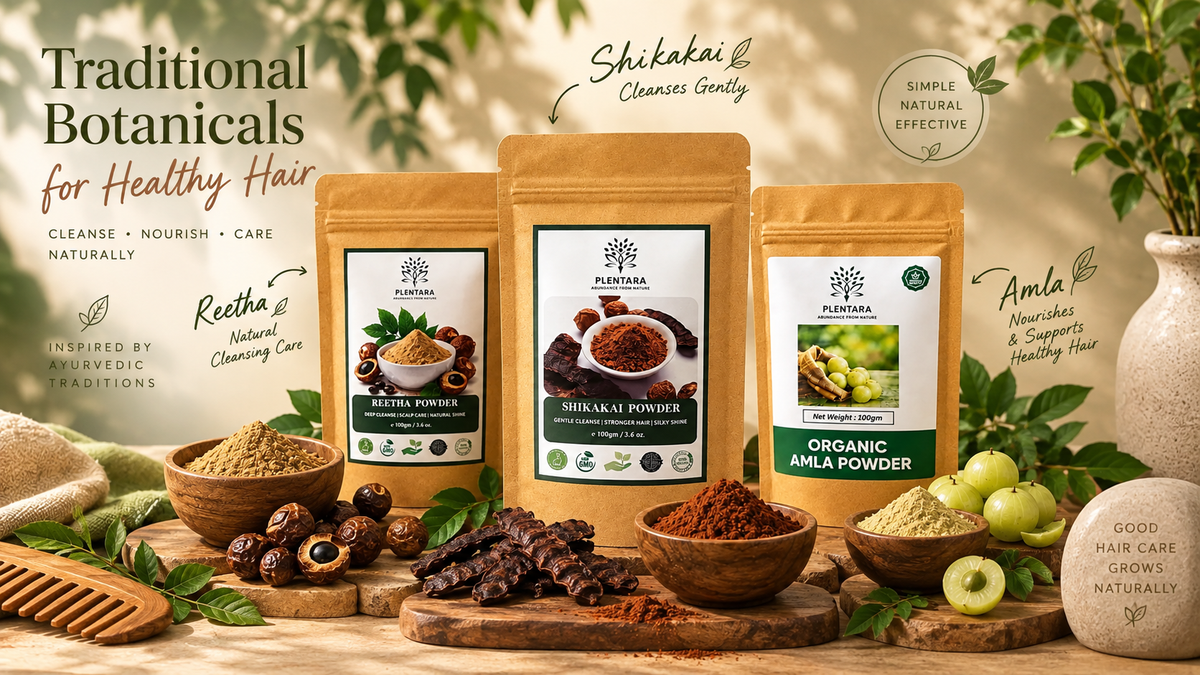
Shikakai Powder for Hair: How to Use It | Plentara Australia
If you are exploring traditional herbal hair care, you may have come across a small but intriguing name: Shikakai.
Used in traditional Indian hair-care practices for generations, Shikakai is a botanical powder made from Acacia concinna. Unlike many modern hair products that come ready to use straight from the bottle, Shikakai powder is prepared with water to create a simple hair-cleansing preparation.
But what exactly is Shikakai powder? How do you use it on your hair? Is it the same as Reetha? Can you combine it with Amla? And how does a traditional herbal cleanser fit into a modern hair-care routine?
In this guide, we explore Shikakai powder in practical terms, including its traditional background, preparation, how to use it, how it compares with Reetha, and what to look for when choosing Shikakai powder in Australia.
Important: Shikakai is a botanical hair-care ingredient associated with traditional use. Traditional use should not be confused with proof of a medical or therapeutic effect. Always follow the instructions supplied with the individual product.
What Is Shikakai Powder?
Shikakai powder is made by drying and finely grinding the Shikakai plant, Acacia concinna.
The name Shikakai is commonly translated as "fruit for hair", reflecting its long association with traditional Indian hair-care practices.
In traditional hair routines, Shikakai has primarily been associated with hair cleansing rather than plant-based hair colouring.
This makes it different from botanicals such as Henna and Indigo, which are commonly used in plant-based colouring routines, and different from powders that are primarily prepared as hair masks.
Plentara's Shikakai Powder is made from 100% Shikakai (Acacia concinna) and is positioned as a botanical hair cleanser. The product is supplied in a 100 g format and includes preparation instructions for use as a shampoo.
Shikakai in Traditional Indian Hair Care
Shikakai has a long-standing place in traditional Indian hair-care practices.
Before modern shampoos became commonplace, plant-based ingredients were prepared in different ways to cleanse and care for the hair. Shikakai became particularly associated with cleansing preparations because the fruit contains naturally occurring plant compounds known as saponins.
Saponins are naturally occurring compounds found in various plants and are known for their ability to produce foam or lather when mixed with water.
This is one reason Shikakai is often discussed alongside another traditional cleansing botanical: Reetha, or soapnut.
The two ingredients are related in their traditional cleansing role, but they are not the same plant.
That distinction matters when choosing an herbal hair powder.
What Is Shikakai Powder Traditionally Used For?
Shikakai is traditionally associated with hair cleansing.
A Shikakai preparation can be mixed with water to form a paste and applied to wet hair before rinsing.
Plentara's product directions recommend mixing 2–3 teaspoons of Shikakai Powder with warm water, applying the resulting paste to wet hair, massaging it into the scalp, leaving it for approximately five minutes and then rinsing thoroughly.
Always follow the current instructions supplied with your product, as preparation directions can vary between formulations.
The important distinction is that Shikakai should be approached as a hair-care cleanser, not as a treatment for a medical scalp condition or a guaranteed solution for hair loss.
How to Use Shikakai Powder as a Hair Cleanser
Using a powder instead of a conventional liquid shampoo requires a little preparation.
Fortunately, the process is quite straightforward.
Step 1: Measure the Shikakai Powder
Start with the quantity recommended by the product instructions.
For Plentara's Shikakai Powder, the suggested preparation is 2–3 teaspoons.
If you are using another Shikakai product, follow that product's directions rather than automatically applying the same ratio.
Step 2: Add Warm Water
Place the powder in a clean bowl and gradually add warm water.
Mix until you create a smooth paste that is practical to apply to your hair.
Avoid making the mixture unnecessarily watery. A manageable paste is easier to distribute through wet hair.
Step 3: Wet Your Hair
Thoroughly wet your hair before applying the Shikakai preparation.
This helps the paste spread more easily through the hair.
Step 4: Apply to the Hair and Scalp
Apply the prepared Shikakai paste to your wet hair.
Distribute it gently rather than aggressively scrubbing the scalp.
A simple, controlled application is preferable to treating your scalp like you're trying to start a campfire with two sticks.
Step 5: Leave It for the Recommended Time
Plentara's current product directions recommend leaving the preparation on for approximately five minutes.
Do not assume that leaving an herbal preparation on for significantly longer will produce a better result.
Step 6: Rinse Thoroughly
Rinse your hair thoroughly with water.
Make sure the powder has been removed from the hair and scalp.
If your hair feels particularly dry, tangled or difficult to manage after cleansing, you may prefer to follow your routine with a suitable conditioner.
How Often Should You Use Shikakai Powder?
There isn't one universal schedule that works for everyone.
Your hair-washing routine can depend on factors such as:
-
Hair texture
-
Scalp oiliness
-
Hair length
-
Styling-product use
-
Exercise and lifestyle
-
Environmental conditions
-
Personal preference
-
How your hair feels after washing
Rather than following a rigid schedule, start with the product directions and observe how your hair and scalp respond.
If you are completely new to herbal hair powders, starting with a simple routine can also make it easier to understand how your hair responds to the individual ingredient.
Shikakai vs Reetha: What's the Difference?
Shikakai and Reetha are often mentioned together, and for good reason.
Both have traditional associations with plant-based hair cleansing.
However, they are different botanicals.
Shikakai
Botanical name: Acacia concinna
Shikakai is traditionally associated with Indian hair cleansing and is often prepared as a botanical hair cleanser.
Reetha
Common name: Soapnut
Botanical name: Sapindus mukorossi
Reetha contains naturally occurring saponins and has traditionally been used in cleansing preparations.
Plentara's Reetha Powder is made from 100% pure Sapindus mukorossi and includes directions for preparing it as a shampoo or combining it with Shikakai and Amla for a hair-care preparation.
Explore Plentara Natural Reetha Powder
So which one should you choose?
That depends on the type of botanical hair-care routine you want to explore.
If you specifically want to explore Shikakai, start with Shikakai.
If you want to explore Reetha, use Reetha according to its own product directions.
If you want to explore a combination, make sure the individual products provide appropriate preparation guidance before mixing them.
Can You Mix Shikakai With Amla and Reetha?
Yes, some traditional and product-specific hair-care preparations combine these botanicals.
However, the important point is:
Don't assume every herbal powder can automatically be mixed with every other herbal powder.
Different products can have different preparation requirements.
Plentara's Shikakai Powder specifically provides a suggested hair-mask preparation involving Reetha Powder and Amla Powder.
Plentara's Reetha Powder likewise provides a suggested hair-mask preparation involving Shikakai and Amla.
Explore Plentara's Herbal Hair Powders collection
If you are creating your own preparation, check the instructions for each product first.
A simple routine is generally easier to understand than throwing six different powders into a bowl and hoping the bathroom gods approve.
Shikakai vs Conventional Shampoo
One of the biggest differences between Shikakai powder and conventional shampoo is preparation.
Shikakai Powder
-
Comes in a dry botanical form
-
Requires preparation before use
-
Can be explored as an individual botanical ingredient
-
Has traditional associations with Indian hair cleansing
-
Requires you to follow product-specific preparation instructions
Conventional Shampoo
-
Comes ready to use
-
Has a formulated cleansing system
-
Can contain multiple cleansing, conditioning, fragrance and other cosmetic ingredients
-
Is generally more convenient for everyday use
Neither format needs to be universally better.
The more useful question is:
Which type of hair-care routine suits you and your preferences?
If convenience is your priority, a ready-to-use shampoo may be simpler.
If you enjoy preparing individual botanical ingredients and exploring traditional hair-care practices, Shikakai powder offers a different experience.
For more information about Ayurvedic-inspired shampoo and conditioner routines, read Plentara's guide to Ayurvedic Shampoo and Conditioner: Benefits, Ingredients & How to Use.
Can Shikakai Replace Shampoo?
Shikakai can be used as a traditional botanical hair cleanser, and Plentara provides directions for preparing its Shikakai Powder as a shampoo.
However, the experience is different from using a conventional ready-to-use shampoo.
A Shikakai preparation:
-
Requires measuring
-
Needs to be mixed with water
-
Needs to be applied manually
-
Requires thorough rinsing
-
May feel different from a commercially formulated shampoo
If you prefer simple, ready-to-use products, a conventional or Ayurvedic-inspired shampoo may be more convenient.
If you enjoy traditional botanical preparations, Shikakai can be incorporated into a different kind of cleansing routine.
The choice is ultimately about the formulation, intended use and routine that works for you.
Is Shikakai Suitable for All Hair Types?
Plentara currently describes its Shikakai Powder as suitable for all hair types.
However, "suitable for all hair types" does not mean that every individual will have exactly the same experience.
Hair texture, scalp condition, previous treatments and individual sensitivities can all influence how a product feels.
If your hair is particularly dry, chemically treated, coloured or fragile, introduce a new cleansing product thoughtfully and pay attention to how your hair responds.
If you experience persistent scalp irritation or other symptoms, seek appropriate professional advice rather than attempting to treat the underlying issue with herbal powders.
Shikakai for Dry, Oily and Textured Hair
For dry-feeling hair
If your hair tends to feel dry after cleansing, consider how Shikakai fits into the rest of your routine.
You may prefer to follow cleansing with an appropriate conditioner or other compatible hair-care product.
For oily hair
If your scalp becomes oily quickly, cleansing frequency is an important part of your overall routine.
Start according to the product directions and adjust your routine based on your individual needs.
For curly or textured hair
Curly and textured hair can have different cleansing and conditioning preferences.
Pay attention to how your hair behaves after washing and consider following Shikakai cleansing with a conditioner if that suits your routine.
For coloured or chemically treated hair
If your hair has been coloured, straightened or chemically treated, check the product directions carefully before introducing a new botanical preparation.
Your hair professional can also advise you about maintaining chemically treated or coloured hair.
Can Shikakai Help With Hair Growth or Hair Loss?
This is where it is important to separate traditional hair-care use from medical claims.
Shikakai is traditionally associated with hair cleansing, but that does not mean it should be presented as a medically proven treatment for hair loss or a guaranteed hair-growth solution.
Hair loss can have many different causes. Australian health information from Healthdirect recommends speaking with a doctor if you are concerned about significant or unusual hair loss, particularly if you are losing much more hair than usual or experiencing other symptoms.
A botanical hair cleanser and a medical assessment serve completely different purposes.
If you are experiencing persistent hair loss, thinning, bald patches or scalp changes, speak with an appropriate healthcare professional rather than relying solely on a cosmetic or herbal hair-care product.
How to Choose Shikakai Powder in Australia
If you're searching for Shikakai powder in Australia, don't choose solely because a product says "Ayurvedic" or "natural" on the front of the packaging.
Look at the details.
1. Check the botanical name
Look for:
Acacia concinna
This helps you identify the botanical ingredient more precisely.
2. Check whether it is pure or blended
A single-ingredient Shikakai powder provides a straightforward ingredient profile.
A blend may contain several botanicals.
Neither format is automatically preferable. It simply depends on what you want from the product.
3. Check the intended use
Shikakai is traditionally associated with hair cleansing.
Other herbal powders may be intended for:
-
Hair masks
-
Conditioning preparations
-
Botanical beauty routines
-
Plant-based colouring
Don't assume that every herbal powder can be used in the same way.
4. Read the preparation instructions
This is particularly important with powders.
Check:
-
Recommended quantity
-
Mixing instructions
-
Application method
-
Processing time
-
Rinsing instructions
-
Storage requirements
5. Check the complete ingredient information
If you have allergies or known sensitivities, review the product information carefully before use.
6. Buy from a transparent Australian retailer
Look for clear information about the ingredient, intended use, directions and supplier.
Plentara's Shikakai Powder is currently listed as a 100 g product made from 100% Shikakai (Acacia concinna).
How to Store Shikakai Powder
Because Shikakai is supplied as a dry powder, storage matters.
A simple storage routine includes:
-
Keep the package tightly sealed.
-
Store it in a cool, dry location.
-
Keep moisture away from the powder.
-
Use clean, dry utensils when measuring.
-
Avoid unnecessary exposure to direct sunlight.
-
Follow the storage instructions supplied with the product.
-
Pay attention to the product's best-before information.
Moisture can affect powdered botanical products and may change their texture or condition.
Can Shikakai Cause Irritation?
"Natural" does not automatically mean that a product cannot cause an unwanted reaction.
People can respond differently to botanical and cosmetic ingredients.
Before introducing a new topical product:
-
Read the complete ingredient information.
-
Follow the product directions.
-
Check any warnings or precautions.
-
Consider a small-area patch test where appropriate.
-
Avoid applying products to irritated or damaged skin unless the product specifically instructs you to do so.
-
Stop using the product if you experience an unexpected reaction.
For general information about allergic contact dermatitis and cosmetic reactions, DermNet provides an extensive evidence-based resource on contact reactions to cosmetics.
Shikakai as Part of a Simple Herbal Hair-Care Routine
You don't need a complicated routine to explore traditional botanical hair care.
A simple routine could look like this:
1. Cleanse
Prepare and use Shikakai according to the product instructions.
2. Rinse
Rinse thoroughly after the recommended processing time.
3. Condition
If your hair benefits from conditioning after cleansing, use a suitable conditioner according to its instructions.
4. Observe
Pay attention to how your hair and scalp feel after using the product.
5. Keep It Simple
When introducing a new botanical, using one new ingredient at a time can make it easier to understand how your hair responds.
Once you're comfortable with the individual ingredient, you can explore other suitable botanical products according to their instructions.
Shikakai, Amla and Reetha: Understanding the Trio
One reason Shikakai appears so often in traditional herbal hair-care discussions is its connection with other familiar botanicals.
Shikakai
Traditionally associated with cleansing.
Reetha
Traditionally associated with plant-based cleansing and naturally occurring saponins.
Amla
A well-known botanical associated with traditional Ayurvedic hair and beauty practices.
Plentara currently sells all three as individual herbal powders, allowing customers to explore them separately or follow product-specific combination instructions.
Shop Plentara Herbal Hair Powders
For readers interested in exploring the three botanicals together, a separate guide to Amla, Reetha and Shikakai for Haircan provide a useful next step in understanding how these ingredients differ.
Why Explore Shikakai Powder?
Shikakai offers something that ready-to-use hair products don't always provide: a chance to explore a single traditional botanical ingredient and prepare it yourself.
For some people, that preparation is part of the appeal.
You know what botanical you're working with, you prepare it according to the product directions, and you can build a simple hair-care routine around it.
It also makes Shikakai a useful ingredient to understand if you're exploring the wider world of Ayurvedic and botanical hair care.
Frequently Asked Questions About Shikakai Powder
What is Shikakai powder?
Shikakai powder is a finely ground botanical powder made from Acacia concinna. It has a long association with traditional Indian hair-care practices, particularly hair cleansing.
What is Shikakai powder used for?
Shikakai powder is traditionally used as a botanical hair cleanser. Plentara provides directions for preparing its Shikakai Powder with warm water and using it on wet hair.
How do you use Shikakai powder as shampoo?
For Plentara's Shikakai Powder, the suggested preparation is to mix 2–3 teaspoons with warm water to create a paste, apply it to wet hair, massage gently into the scalp, leave for approximately five minutes and rinse thoroughly.
Always follow the current instructions on the product you purchase.
Can I use Shikakai powder every day?
There is no universal daily-use recommendation that applies to every person. Follow the product directions and consider your hair type, scalp and overall hair-washing routine.
Is Shikakai the same as Reetha?
No. Shikakai is Acacia concinna, while Reetha, also known as soapnut, is Sapindus mukorossi. Both are traditionally associated with plant-based hair cleansing, but they are different botanicals.
Can Shikakai and Reetha be used together?
They can be combined in some hair-care preparations. Plentara's product directions specifically provide combination guidance involving Shikakai, Reetha and Amla. Always check the directions for the individual products before mixing them.
Can Shikakai be mixed with Amla?
Yes, Shikakai and Amla can be used together in some traditional and product-specific hair-care preparations. Follow the instructions supplied with the products you are using.
Does Shikakai make hair grow?
Shikakai is traditionally associated with hair cleansing, but it should not be presented as a proven medical treatment for hair loss or a guaranteed hair-growth product.
If you are experiencing significant or persistent hair loss, consult an appropriate healthcare professional.
Is Shikakai better than shampoo?
There isn't a universal answer. Shikakai powder and ready-to-use shampoo are different formats with different preparation methods. The better option depends on your preferences, hair-care routine and the specific product.
Can Shikakai be used on coloured hair?
If your hair is coloured or chemically treated, check the product instructions and consider how the product fits into your existing routine. If you are unsure, consult your hair professional.
How should Shikakai powder be stored?
Keep the powder sealed and protected from moisture. Store it according to the manufacturer's instructions and use clean, dry utensils when measuring it.
Where can I buy Shikakai powder in Australia?
Plentara offers Shikakai Powder online in Australia as part of its Herbal Hair Powders collection.
Final Thoughts
Shikakai is a fascinating example of how traditional botanical ingredients can fit into a modern hair-care routine.
Made from Acacia concinna, Shikakai has a long association with traditional Indian hair cleansing and offers an alternative format to conventional ready-to-use shampoo.
The key is to understand what you're actually using.
Check the botanical ingredient.
Read the preparation instructions.
Use the product according to its intended purpose.
Don't confuse traditional use with medical claims.
And introduce new botanical products thoughtfully, especially if you have sensitive skin, an existing scalp condition or chemically treated hair.
For Australians interested in exploring traditional herbal hair care, Plentara's Shikakai Powder provides a simple starting point.
Explore Plentara Shikakai Powder
You can also explore the wider Plentara Herbal Hair Powders collection to discover other botanicals such as Amla, Reetha, Bhringraj, Brahmi, Hibiscus, Henna and Indigo.