
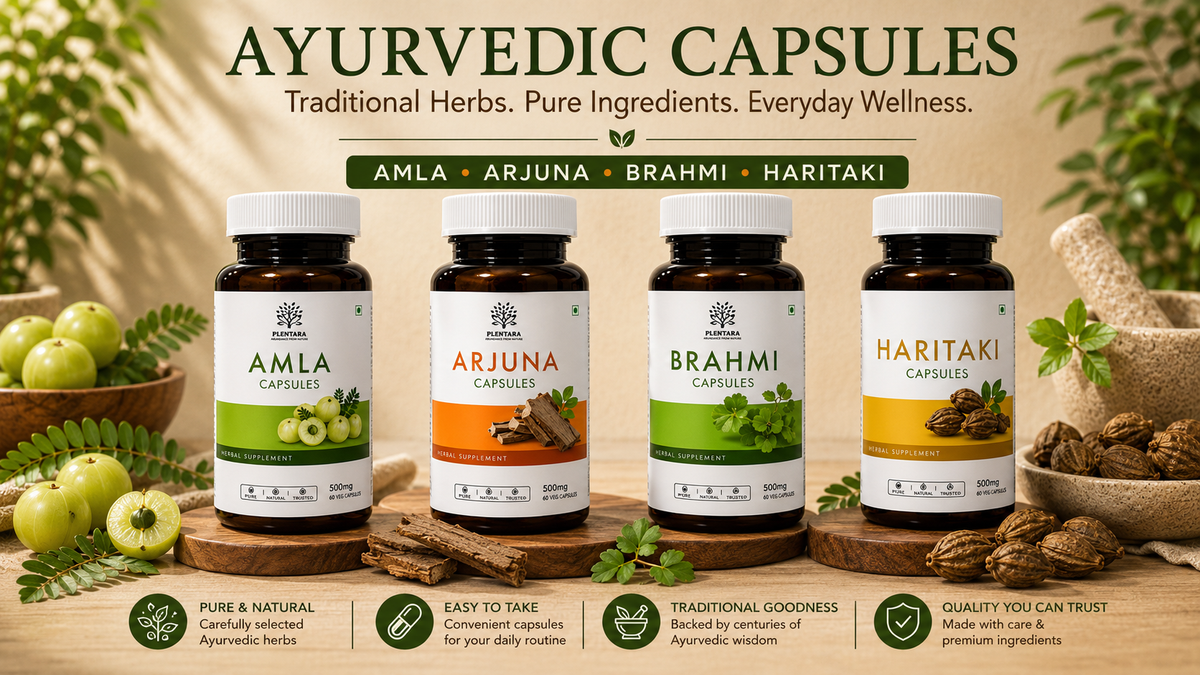
Ayurvedic capsules offer a convenient way to explore traditional herbal ingredients in a familiar, easy-to-use format. For Australians interested in Ayurveda, choosing the right supplement can involve more than simply looking at a product name. Understanding the herb, formulation, ingredient information and intended use can help you make a more informed choice.
Among the many herbs associated with Ayurvedic traditions, Amla, Arjuna, Brahmi and Haritaki are four well-known ingredients that are available in capsule form.
In this guide, we explore what Ayurvedic capsules are, how capsules compare with powders, what makes these four herbs distinctive in traditional Ayurvedic practice, and what Australian consumers should consider when choosing Ayurvedic herbal supplements.
What Are Ayurvedic Capsules?
Ayurvedic capsules are supplement products containing herbs or herbal preparations associated with the traditional Ayurvedic system of medicine.
Ayurveda is a traditional system of medicine originating in India, with a long history of using herbs and other natural materials as part of traditional health and wellness practices.
Modern Ayurvedic supplements can come in several forms, including powders, tablets, oils, liquids and capsules.
Capsules are particularly convenient because they provide a pre-portioned format without requiring the consumer to measure or prepare loose herbal powder.
However, not all Ayurvedic capsules are the same. Ingredients, concentration, preparation method, capsule material and directions can vary between products.
That is why reading the product label and understanding the individual formulation is an important part of choosing an Ayurvedic supplement.
Why Choose Ayurvedic Capsules Instead of Herbal Powders?
Both powders and capsules have a place in traditional herbal routines, but they offer different practical experiences.
Convenience
Capsules are simple to incorporate into an established routine and do not require mixing, measuring or preparing a drink.
Easy-to-Use Format
For people who prefer a pre-portioned format, capsules can be more straightforward than loose herbal powders.
Less Preparation
Herbal powders may need to be measured and mixed with water, food or another preparation depending on their intended use.
Capsules remove that preparation step.
Consistent Product Format
A capsule provides a defined amount of the formulation per capsule, according to the product label.
Suitable for Busy Routines
For Australian consumers balancing work, family and everyday commitments, a simple capsule format can be easier to incorporate into an established wellness routine.
The important point is that capsules are a format, not a guarantee of quality or effectiveness. Ingredient quality, formulation, manufacturing standards and appropriate product information still matter.
Understanding Four Traditional Ayurvedic Herbs
Plentara's Ayurvedic capsule range includes four individual herbal products that are particularly relevant to this guide:
- Amla Capsules
- Arjuna Capsules
- Brahmi Capsules
- Haritaki Capsules
Each comes from a different botanical source and has its own place within traditional Ayurvedic herbal practice.
Amla Capsules
Amla, also known as Indian gooseberry, is traditionally known as Amalaki and is associated with the botanical name Emblica officinalis.
Amla is one of the best-known fruits in Ayurvedic herbal traditions.
Plentara's Amla Capsules are presented as a single-herb Ayurvedic formulation based on Amla.
Why is Amla important in Ayurveda?
Amla has a long history within Ayurvedic traditions and is commonly included in traditional herbal formulations.
Its use extends across many traditional preparations, including powders, blends and other herbal formats.
For consumers interested in traditional Ayurvedic herbs, Amla is an important ingredient to understand because it is also one of the three fruits used in the classical Triphala formulation.
Amla capsules in Australia
When comparing Amla capsules in Australia, look beyond the product name.
Consider:
- Botanical name
- Ingredient quantity
- Number of capsules
- Directions for use
- Storage instructions
- Manufacturer or supplier information
- Product presentation
- Australian regulatory status where applicable
This approach helps you compare products based on actual product information rather than marketing language alone.
Arjuna Capsules
Arjuna, botanically known as Terminalia arjuna, is another important herb in traditional Ayurvedic practice.
The bark of the Arjuna tree has a long history of use in Ayurveda and is frequently discussed in traditional herbal literature.
Plentara's Arjuna Capsules are presented as a single-herb Ayurvedic herbal supplement based on Terminalia arjuna.
Understanding Arjuna as an Ayurvedic herb
Arjuna has a distinctive place in traditional Ayurvedic herbal practice.
When researching Arjuna capsules, consumers may encounter many different health claims online. It is important to distinguish between traditional Ayurvedic use and modern clinical evidence.
A traditional description of an herb should not automatically be interpreted as proof that a modern capsule product will produce a particular medical outcome.
For Australian consumers, product claims should always be checked against the actual product information and applicable regulatory requirements.
Brahmi Capsules
Brahmi is traditionally associated with Bacopa monnieri, a botanical ingredient widely discussed in Ayurvedic herbal traditions.
Plentara's product listing identifies its Brahmi Capsules as a single-herb formulation using Bacopa monnieri.
Brahmi is particularly well known within traditional Ayurvedic discussions of herbs associated with medhya rasayana, a traditional Ayurvedic concept.
What should you know before choosing Brahmi capsules?
The word "Brahmi" can sometimes create confusion because different plants have historically been referred to by the name in different contexts.
For this reason, checking the botanical name on the product label is useful.
For Plentara's product, the listed botanical identity is Bacopa monnieri.
This is one example of why botanical names can be more useful than common names when comparing herbal supplements.
Haritaki Capsules
Haritaki, botanically known as Terminalia chebula, is a traditional Ayurvedic herb derived from the fruit of the Haritaki tree.
It is one of the three fruits traditionally associated with Triphala.
Plentara's Haritaki Capsules are presented as a single-herb Ayurvedic formulation based on Terminalia chebula.
Haritaki in traditional Ayurveda
Haritaki has a long history within Ayurvedic herbal practice and appears in a variety of traditional preparations.
Modern consumers may encounter a wide range of claims about Haritaki online. As with other Ayurvedic herbs, traditional descriptions should be kept distinct from claims of modern clinical effectiveness.
If you're considering Haritaki capsules in Australia, pay attention to the product's formulation, directions and regulatory presentation rather than relying on broad internet claims.
Amla vs Arjuna vs Brahmi vs Haritaki
One of the easiest ways to understand these products is to look at their individual identities.
| Ayurvedic herb | Botanical name | Traditional context | Plentara format |
|---|---|---|---|
| Amla | Emblica officinalis | Traditional Ayurvedic herbal practice | Capsules |
| Arjuna | Terminalia arjuna | Traditional Ayurvedic herbal practice | Capsules |
| Brahmi | Bacopa monnieri | Traditional Ayurvedic herbal practice | Capsules |
| Haritaki | Terminalia chebula | Traditional Ayurvedic herbal practice | Capsules |
These are different single-herb products, rather than four interchangeable versions of the same supplement.
The right product to explore depends on the individual herb, formulation and intended use described on the product label.
How to Choose Ayurvedic Capsules in Australia
If you are searching for Ayurvedic capsules in Australia, it is worth taking a few minutes to evaluate the product before purchasing.
1. Check the Botanical Name
Common names can vary between regions and traditions.
A botanical name provides a clearer way to identify the plant used in the formulation.
For example:
- Amla: Emblica officinalis
- Arjuna: Terminalia arjuna
- Brahmi: Bacopa monnieri
- Haritaki: Terminalia chebula
2. Read the Ingredient Information
Look at the complete ingredient list rather than focusing only on the front of the package.
Check whether the product contains:
- A single herb
- Multiple herbs
- Extracts
- Herbal powders
- Capsule materials
- Other added ingredients
3. Check the Directions
Different products can have different recommended directions.
Always follow the directions provided on the product packaging rather than assuming that every Ayurvedic capsule should be taken in the same way.
4. Consider the Product's Intended Use
Avoid choosing a supplement simply because an online article promises a particular result.
Consider what the product is actually presented and intended for, and whether that aligns with your personal needs.
5. Look for Clear Product Information
A trustworthy product listing should provide useful information about the formulation, quantity, directions and supplier.
Transparent product information makes it easier for consumers to make informed purchasing decisions.
6. Consider Australian Regulatory Requirements
Australian consumers should also consider whether an Ayurvedic capsule is being supplied as a therapeutic good and, if so, whether the product has the appropriate Australian regulatory status.
The TGA states that listed medicines must be included in the Australian Register of Therapeutic Goods before supply and that listed medicines can only make permitted low-level indications.
For therapeutic products, websites are also considered advertising and claims need to align with the applicable regulatory framework.
What Should You Look for When Buying Ayurvedic Supplements Online?
Buying herbal supplements online is convenient, but product information matters.
Before placing an order, consider:
Product identity
Is the herb clearly identified?
Botanical name
Is the scientific name provided?
Ingredients
Can you see what is actually inside the capsule?
Directions
Are directions for use clearly provided?
Quantity
Does the listing clearly state the number of capsules?
Supplier information
Can you identify the business responsible for supplying the product?
Australian suitability
If the product is intended for the Australian market, does its presentation and regulatory status make sense for the type of product being sold?
These details are more useful than simply looking for words such as "premium", "natural" or "powerful".
Why Botanical Names Matter in Ayurvedic Supplements
One of the most useful habits when shopping for herbal supplements is learning to look beyond common names.
For example, "Brahmi" is a traditional common name, while Bacopa monnieri identifies the botanical ingredient used in Plentara's Brahmi Capsules.
Similarly, Amla is identified as Emblica officinalis, Arjuna as Terminalia arjuna, and Haritaki as Terminalia chebula.
This makes it easier to compare products and understand exactly which botanical ingredient is being discussed.
Ayurvedic Capsules and Traditional Herbal Knowledge
Ayurveda represents a traditional system of medicine with its own concepts, terminology and history.
It is useful to distinguish this traditional knowledge from modern scientific research.
An herb may have a long history of traditional use without that history automatically establishing clinical effectiveness for every modern supplement containing that herb.
The TGA specifically distinguishes traditional indications from scientific indications and requires traditional claims to be supported by appropriate evidence of traditional use.
For consumers, this means that phrases such as "traditionally used in Ayurveda" should not be interpreted as meaning "clinically proven."
This distinction helps create more transparent and responsible herbal-product communication.
A Simple Way to Compare Ayurvedic Capsules
When comparing several Ayurvedic supplements, use a simple checklist.
| What to compare | Why it matters |
|---|---|
| Herb | Identifies the primary botanical |
| Botanical name | Helps avoid confusion between common names |
| Form | Powder, extract, capsule or blend |
| Quantity | Helps compare package sizes |
| Ingredients | Shows what is actually included |
| Directions | Explains how the product is intended to be used |
| Warnings | Important for responsible use |
| Supplier | Provides accountability |
| Regulatory information | Important for Australian therapeutic goods |
| Product claims | Should be appropriate and supportable |
This approach is much more useful than choosing a product based solely on the number of advertised "benefits".
Amla, Arjuna, Brahmi and Haritaki: Four Distinct Ayurvedic Herbs
Although these four products belong to the same broader Ayurvedic capsule category, they should not be treated as interchangeable.
Amla is traditionally associated with the fruit of Emblica officinalis.
Arjuna comes from Terminalia arjuna and has a long history within Ayurvedic herbal traditions.
Brahmi, in Plentara's formulation, refers to Bacopa monnieri.
Haritaki refers to Terminalia chebula.
Each represents a different botanical ingredient and a different part of Ayurvedic herbal knowledge.
That makes individual-herb capsules useful for consumers who want to explore specific traditional botanicals rather than automatically choosing a multi-herb blend.
Are Ayurvedic Capsules Right for Everyone?
There is no single herbal supplement format that is appropriate for every person.
Individual circumstances can affect whether a particular supplement is suitable, including:
- Age
- Pregnancy or breastfeeding
- Existing health conditions
- Prescription or other medicines
- Allergies or sensitivities
- The specific ingredients and dose
- The product's intended use
If you have a medical condition, take prescription medicines, are pregnant or breastfeeding, or are unsure whether a particular herbal supplement is suitable for you, speak with an appropriately qualified healthcare professional before using it.
Always read the product label and follow the directions provided.
Frequently Asked Questions About Ayurvedic Capsules
What are Ayurvedic capsules?
Ayurvedic capsules are supplement products containing herbs or herbal preparations associated with traditional Ayurvedic practice. They provide these ingredients in a convenient capsule format.
What are the most common Ayurvedic capsules?
There are many Ayurvedic herbs available in capsule form. Common examples include Amla, Brahmi, Haritaki, Ashwagandha and Arjuna, although availability and formulations vary between brands.
What are Amla capsules?
Amla capsules contain Amla, also known as Amalaki or Indian gooseberry. Plentara identifies its Amla Capsules with the botanical name Emblica officinalis.
What are Arjuna capsules?
Arjuna capsules contain the herb Arjuna, botanically identified as Terminalia arjuna. Arjuna has a long history of use within traditional Ayurvedic herbal practice.
What are Brahmi capsules?
Brahmi capsules contain Brahmi. Plentara identifies the botanical ingredient in its Brahmi Capsules as Bacopa monnieri.
What are Haritaki capsules?
Haritaki capsules contain Haritaki, botanically identified as Terminalia chebula. Haritaki is one of the three fruits traditionally used in the classical Ayurvedic formulation known as Triphala.
Are Ayurvedic capsules available in Australia?
Yes. Ayurvedic and herbal capsules are available through Australian retailers and online suppliers. The regulatory status and permitted claims can differ between products, so Australian consumers should check the product information and applicable regulatory details.
Are Ayurvedic capsules the same as herbal supplements?
The terms can overlap, but "Ayurvedic" specifically refers to the traditional Ayurvedic context behind the ingredients or formulation. Herbal supplements can come from many different herbal traditions.
Should I choose capsules or powder?
It depends on your preference and the product. Capsules are convenient and require little preparation, while powders can offer more flexibility in how they are incorporated into a routine.
How should Ayurvedic capsules be taken?
Always follow the directions provided with the specific product. Different herbs and formulations can have different directions for use.
Are Ayurvedic capsules scientifically proven?
Traditional Ayurvedic use and scientific clinical evidence are different forms of evidence. A traditional history of use should not automatically be interpreted as proof of clinical effectiveness. TGA guidance distinguishes traditional indications from scientific indications.
Final Thoughts
Ayurvedic capsules provide a convenient way to explore traditional herbal ingredients in a modern capsule format.
For Australian consumers, the most useful starting point is not simply searching for the product with the longest list of advertised benefits. Instead, look at the herb, botanical name, formulation, ingredient information, directions, supplier and applicable Australian regulatory information.
Plentara's Ayurvedic capsule range includes Amla, Arjuna, Brahmi and Haritaki, each presented as an individual herbal formulation.
Whether you are new to Ayurveda or already familiar with traditional herbal practices, understanding the individual botanicals can help you make more informed choices.
Explore Plentara's Ayurvedic Capsules & Herbal Supplements collection to discover Amla, Arjuna, Brahmi and Haritaki capsules.