
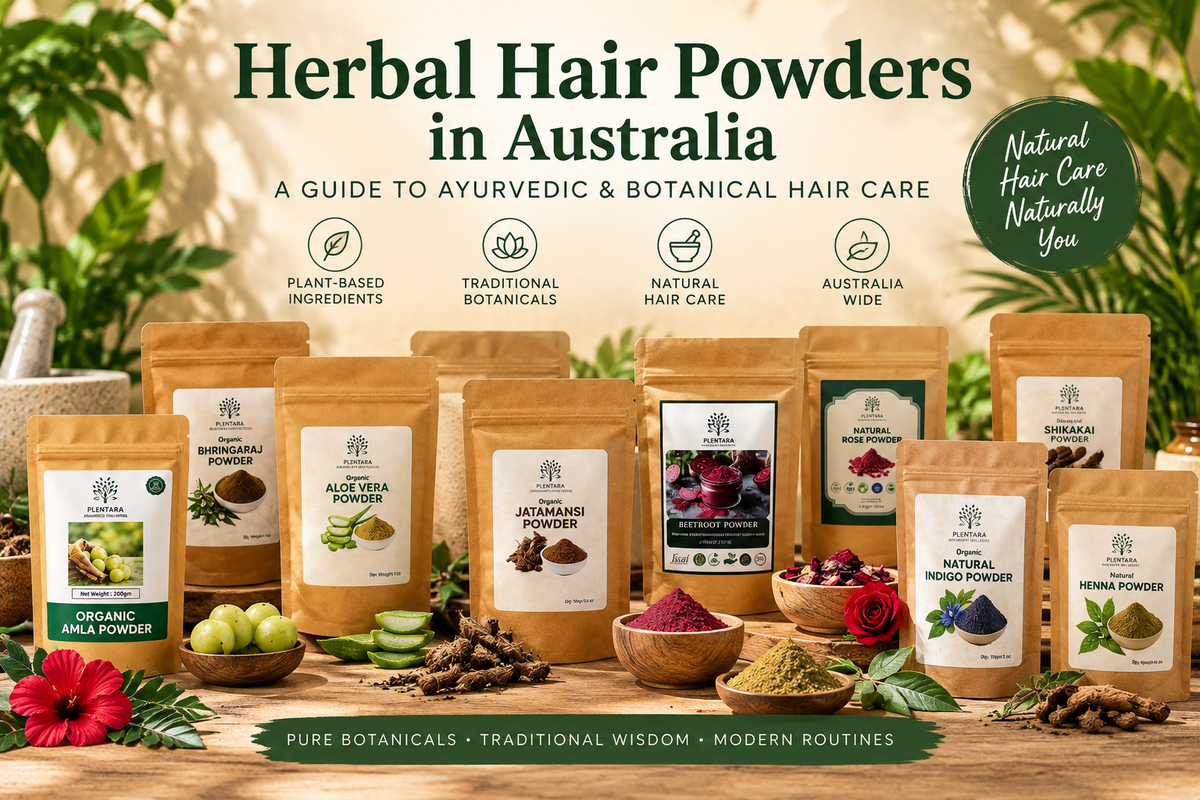
Herbal Hair Powders in Australia: A Guide to Ayurvedic & Botanical Hair Care
Herbal hair powders offer a simple way to explore traditional botanical hair-care practices using individual plant ingredients and carefully prepared blends.
From Amla and Bhringraj to Shikakai, Reetha, Brahmi, Henna and Indigo, different powders have different characteristics and may be used in cleansing, hair-mask, conditioning or plant-based colouring routines.
For Australians looking for herbal hair powders, the biggest challenge isn't finding a powder. It's understanding which botanical you're buying, what it's intended for, how it should be prepared and how it fits into your hair-care routine.
This guide explores some of the herbal hair powders available from Plentara, how they differ, how to use them responsibly and what to look for when buying botanical hair powders in Australia.
What Are Herbal Hair Powders?
Herbal hair powders are finely ground botanical ingredients made from different parts of plants, including leaves, flowers, fruits, roots and seeds.
Depending on the botanical and its intended use, a powder may be prepared as:
- A hair mask
- A cleansing preparation
- A conditioning treatment
- A botanical hair-care blend
- A plant-based hair-colouring preparation
Unlike ready-to-use creams, shampoos or conditioners, powdered botanicals generally require some preparation before application.
The preparation method isn't universal. Amla powder, Shikakai powder, Reetha powder and Henna powder, for example, should not automatically be prepared in the same way.
Always follow the instructions provided with the individual product.
Explore Plentara's Herbal Hair Powders collection
Why Are Herbal Hair Powders Popular?
Interest in botanical hair care has grown alongside broader interest in traditional beauty routines and plant-based personal care.
Herbal powders can be appealing because they allow people to explore individual botanical ingredients rather than relying entirely on ready-made formulations.
Some people choose powders because they:
- Come in a simple dry format
- Can be prepared according to product directions
- Allow individual botanicals to be explored
- Can be incorporated into DIY-style hair-care routines
- Are available as single ingredients or blends
- Connect modern personal care with traditional botanical practices
However, natural, herbal or Ayurvedic does not automatically mean that every product is suitable for every person.
The ingredient list, intended use, preparation method and product directions should always come first.
Popular Herbal Hair Powders in Australia
Plentara's Herbal Hair Powders collection brings together individual botanicals, blends and plant-based hair-colouring powders.
Here are the products we are focusing on in this guide.
1. Organic Amla Powder
Amla, also known as Indian gooseberry, is one of the best-known botanicals associated with Ayurvedic traditions.
Plentara's Organic Amla Powder is a finely milled botanical powder that can be explored as part of a topical hair-care routine according to its product directions.
Amla is commonly encountered in traditional Indian hair and beauty practices and can also be combined with other suitable botanical powders when the individual product instructions allow it.
2. Aloe Vera Powder Organic
Aloe vera is widely used in personal-care and cosmetic preparations.
Plentara's Aloe Vera Powder Organic is made from organically grown Aloe vera and is included in the Herbal Hair Powders range.
For people interested in botanical hair and beauty routines, aloe vera powder provides another ingredient to explore.
As with other powdered botanicals, preparation and application should follow the product's specific directions.
Explore Aloe Vera Powder Organic
3. Bhringraj Powder Organic
Bhringraj is a traditional Ayurvedic botanical associated with Indian hair-care practices.
Plentara's Bhringraj Powder Organic contains Eclipta alba and is presented as a single-herb botanical powder.
It can be prepared as a hair mask according to the supplied product directions.
For people exploring Ayurvedic hair powders in Australia, Bhringraj is one of the individual botanicals worth understanding.
Explore Bhringraj Powder Organic
4. Brahmi Powder
Brahmi is another botanical commonly encountered in Ayurvedic traditions and traditional Indian beauty routines.
Plentara's Natural Brahmi Powder provides another option for people interested in individual botanical powders.
Brahmi can also be incorporated into a broader herbal hair-care preparation when the relevant product directions permit it.
When purchasing botanical powders, checking the botanical name and intended use can be helpful because common names can sometimes be used differently across products and traditions.
Explore Natural Brahmi Powder
5. Shikakai Powder
Shikakai has a long association with traditional Indian hair cleansing.
Plentara's Shikakai Powder contains Acacia concinna and is positioned as a botanical hair cleanser.
Unlike powders primarily used as masks or hair-colouring ingredients, Shikakai is particularly relevant to people interested in exploring plant-based hair cleansing routines.
Explore Shikakai Powder
6. Natural Reetha Powder
Reetha, also known as soapnut, has traditionally been used in Indian hair-care practices.
Plentara's Natural Reetha Powder is made from Sapindus mukorossi.
Reetha contains naturally occurring saponins and is traditionally associated with cleansing preparations.
If you're exploring herbal alternatives to conventional cleansing products, Reetha can be an interesting botanical to investigate.
Explore Natural Reetha Powder
7. Hibiscus Powder
Hibiscus is another botanical frequently found in traditional Indian beauty practices.
Plentara's Hibiscus Powder is made from dried hibiscus flowers and finely milled into a powder.
Its botanical and floral character makes it suitable for people interested in experimenting with different plant-based beauty preparations.
As always, follow the product-specific directions rather than assuming that every herbal powder should be prepared as a standard hair mask.
Explore Hibiscus Powder
8. Jatamansi Organic Powder
Jatamansi is a traditional Ayurvedic botanical derived from Nardostachys jatamansi.
Plentara's Jatamansi Organic Powder is another individual botanical available within its wider powder range.
For topical hair-care applications, preparation should follow the product's instructions.
Jatamansi can also be considered alongside other botanical powders when a particular preparation allows them to be combined.
Explore Jatamansi Organic Powder
9. Beetroot Powder
Beetroot powder is another botanical powder included in the collection.
Its rich natural colour makes beetroot an interesting ingredient for people exploring plant-based beauty preparations and botanical powders.
However, it should not automatically be treated as a replacement for dedicated hair-colouring products such as Henna or Indigo.
If you're considering Beetroot Powder for a topical preparation, follow the specific product directions.
Explore Beetroot Powder
10. Natural Rose Powder
Rose has a long history in traditional beauty rituals across South Asia and other regions.
Plentara's Natural Rose Powder is made from rose and is positioned for both skin and hair-oriented botanical beauty routines.
Its floral profile makes it particularly interesting for people who enjoy incorporating aromatic botanical ingredients into personal-care preparations.
Explore Natural Rose Powder
11. Herb Mix Powder
If you prefer a blend rather than selecting individual botanicals, Plentara's Herb Mix Powder offers another option.
The blend contains:
- Amla
- Shikakai
- Brahmi
- Rose
- Arnica
- Henna
Because it contains multiple botanicals, it provides a different approach from choosing individual powders separately.
The product is described for external hair-care use, so its own directions should be followed carefully.
Explore Herb Mix Powder
12. Natural Henna Powder
Henna is one of the most recognisable plant-based hair-colouring ingredients.
Plentara's Natural Henna Powder is made from Lawsonia inermis and is intended as a plant-based hair-colouring option.
Henna is generally associated with warm red, copper and reddish-brown colour directions, although the final appearance depends heavily on the starting hair colour and application process.
Explore Natural Henna Powder
For a deeper look at Henna and Indigo hair colouring, link this section to your separate article:
[Henna & Indigo Hair Colour in Australia → https://plentara.com.au/blogs/news/henna-indigo-hair-colour-in-australia ]
13. Natural Indigo Powder
Indigo is another traditional plant-based hair-colouring ingredient.
Plentara's Natural Indigo Powder is derived from Indigofera tinctoria and is available for people exploring botanical hair-colouring practices.
Indigo is generally associated with darker colour directions, although the final result depends on factors such as the starting hair colour and application process.
Henna and Indigo can be used as part of different colouring approaches, but their preparation methods can differ.
Explore Natural Indigo Powder
Herbal Hair Powders: Which One Should You Choose?
There isn't one herbal hair powder that is universally right for everyone.
Instead, think about what you want the powder to do within your routine.
| If you're exploring... | Powders to investigate |
|---|---|
| Botanical hair masks | Amla, Bhringraj, Brahmi, Jatamansi |
| Traditional cleansing | Shikakai, Reetha |
| Botanical beauty blends | Hibiscus, Rose, Aloe Vera |
| Multi-botanical preparations | Herb Mix Powder |
| Plant-based hair colour | Henna, Indigo |
| Individual botanicals | Single-herb powders |
| A different botanical ingredient | Beetroot Powder |
This isn't a ranking. These products have different intended uses and characteristics, so the best starting point depends on what you're looking for.
Herbal Hair Powders vs Ready-to-Use Hair Products
One of the biggest differences between herbal powders and ready-to-use hair products is preparation.
Herbal Hair Powders
Powders generally need to be prepared before use.
This can give you more flexibility in creating a routine around individual botanical ingredients, but it also means spending more time preparing the product.
Ready-to-Use Products
Shampoos, conditioners, masks and other ready-to-use products are formulated for direct application according to their instructions.
They can be more convenient if you prefer not to mix or prepare your hair-care products.
Neither format is automatically better.
The choice comes down to the product, its intended use and the type of routine you prefer.
How to Use Herbal Hair Powders
There is no universal recipe for herbal hair powders.
The preparation method depends on the specific product.
A general preparation process may involve:
Step 1: Read the product directions
Before mixing anything, check how the manufacturer recommends preparing and using the powder.
Step 2: Measure the required amount
Use the quantity specified by the product instructions.
Step 3: Add the recommended liquid
Some powders may be prepared with water or another specified ingredient.
Don't assume that the same liquid or ratio works for every botanical.
Step 4: Mix
Create the consistency specified or recommended for the particular product.
Step 5: Apply
Apply according to the product directions.
Step 6: Follow the recommended processing time
Don't assume that leaving a product on longer will necessarily produce a better result.
Step 7: Rinse
Rinse thoroughly according to the product instructions.
Henna and Indigo may require different preparation and application methods, so follow their individual instructions rather than using the general process above.
Can You Mix Different Herbal Hair Powders?
Some botanical powders can be combined, but not every powder should automatically be mixed with every other powder.
Before creating your own blend:
- Check each product's instructions.
- Confirm that the products are intended for topical use.
- Check whether the manufacturer provides mixing guidance.
- Start with a simple preparation.
- Consider a patch test where appropriate.
- Stop using a product if irritation or an unexpected reaction occurs.
A simple routine is often easier to understand than immediately creating a botanical chemistry experiment in the bathroom. 🌿
How to Choose Herbal Hair Powder in Australia
When searching for herbal hair powder in Australia, don't choose solely based on the front of the package or a list of advertised benefits.
Instead, look at the complete product information.
1. Check the botanical name
Common names can sometimes be ambiguous.
A botanical name gives you a clearer way to identify the plant.
Examples include:
- Amla: Emblica officinalis
- Bhringraj: Eclipta alba
- Shikakai: Acacia concinna
- Reetha: Sapindus mukorossi
- Jatamansi: Nardostachys jatamansi
- Henna: Lawsonia inermis
- Indigo: Indigofera tinctoria
2. Check whether it is a single herb or blend
A single botanical gives you a straightforward ingredient profile.
A blend contains multiple ingredients, which can be useful if that's what you're looking for, but makes it even more important to read the complete ingredient information.
3. Check the intended use
Some powders are intended for cleansing.
Others may be intended for hair masks, botanical beauty preparations or hair colouring.
Don't assume that every powder serves the same purpose.
4. Read the preparation instructions
The preparation method can vary substantially between products.
5. Check storage information
Keep powders sealed and protected from moisture.
Follow the storage information supplied with the product.
6. Consider the claims being made
Be cautious of products making sweeping claims about treating hair loss, reversing baldness, curing scalp conditions or producing guaranteed biological effects.
Australian regulators distinguish cosmetic products from therapeutic goods partly through the claims made, ingredients/composition and intended use.
Herbal Hair Powders and Australian Cosmetic Requirements
For Australian consumers and businesses, understanding the cosmetic/therapeutic distinction is important.
The TGA explains that products can fall into different regulatory categories depending on factors including claims, ingredients or composition, how they are used and whether they are excluded from therapeutic-goods regulation.
Hair dyes and hair-colouring products are among examples that can be excluded from therapeutic-goods regulation under applicable conditions. AICIS also lists hair dyes, shampoos, conditioners and other hair-care products among cosmetics when the relevant criteria are met.
This is why product descriptions should stay aligned with the product's actual cosmetic purpose.
For example:
Cosmetic-oriented wording:
"Used as part of a botanical hair-care routine."
is materially different from:
"Treats hair loss."
The second type of claim can raise therapeutic classification issues.
For businesses importing or manufacturing cosmetic ingredients in Australia, AICIS provides additional guidance about cosmetic ingredients and obligations.
TGA: Determining if a product is a cosmetic or therapeutic good
AICIS: Is my product a cosmetic?
AICIS: Cosmetics and therapeutics
Are Herbal Hair Powders Safe for Everyone?
There isn't a single answer that applies to every herbal powder.
Different products contain different botanicals, and people can respond differently to cosmetic ingredients.
Before using a new powder:
- Read the complete ingredient information.
- Follow the product directions.
- Check any warnings or precautions.
- Consider patch testing where appropriate.
- Avoid applying products to irritated or damaged skin unless the product specifically directs you to do so.
- Stop using the product if you experience an unexpected reaction.
Hair dyes and plants can both be associated with contact dermatitis in susceptible people.
For specific medical concerns or persistent reactions, consult an appropriate healthcare professional.
How to Store Herbal Hair Powders
Powdered botanicals should be protected from moisture and contamination.
A simple storage routine includes:
- Keep the package tightly sealed.
- Store in a cool, dry location.
- Keep water away from the powder.
- Use clean, dry utensils.
- Avoid unnecessary exposure to direct sunlight.
- Follow the manufacturer's storage instructions.
- Pay attention to the product's best-before information.
Moisture can affect powdered products and may change their texture or condition.
Why Choose Individual Herbal Powders?
One advantage of individual herbal powders is that you can understand exactly which botanical you're exploring.
For example:
Amla gives you an individual botanical ingredient.
Bhringraj gives you another.
Shikakai provides a different traditional hair-care role.
Henna and Indigo provide plant-based colouring options.
This can make it easier to build a routine around specific ingredients rather than purchasing a large blend without knowing which botanicals it contains.
Plentara Herbal Hair Powders
Plentara's Herbal Hair Powders collection brings together a variety of botanical powders for Australians interested in naturally inspired personal-care routines.
The collection currently includes products spanning:
- Amla
- Aloe Vera
- Bhringraj
- Brahmi
- Jatamansi
- Beetroot
- Rose
- Shikakai
- Reetha
- Hibiscus
- Herbal blends
- Henna
- Indigo
The collection currently shows 14 products, so this article intentionally focuses on the 13 products we've identified from the collection screenshot and Plentara's published product content.
Shop Plentara Herbal Hair Powders
Frequently Asked Questions
What are herbal hair powders?
Herbal hair powders are finely ground botanical ingredients used in traditional and naturally inspired hair-care routines. Depending on the ingredient, they may be used for cleansing, masks, conditioning preparations or plant-based hair colouring.
Which herbal hair powder is best?
There isn't one herbal powder that is best for everyone. Different powders have different ingredients and intended uses. Consider what you're looking for and follow the individual product directions.
What is Amla powder used for in hair care?
Amla is a traditional botanical associated with Indian and Ayurvedic hair-care practices. Plentara's Organic Amla Powder can be explored as part of a topical hair-care routine according to its product directions.
What is Bhringraj powder?
Bhringraj is a traditional Ayurvedic botanical. Plentara's Bhringraj Powder Organic contains Eclipta alba and is offered as an individual botanical powder.
What is Shikakai powder?
Shikakai is a botanical traditionally associated with Indian hair cleansing. Plentara's Shikakai Powder contains Acacia concinna.
What is Reetha powder?
Reetha, also known as soapnut, is traditionally associated with plant-based cleansing practices. Plentara's Natural Reetha Powder is made from Sapindus mukorossi.
Can I mix different herbal hair powders?
Some powders can be combined, but this depends on the individual products. Always check the product directions before creating a mixture.
Can herbal powders colour hair?
Some herbal powders, particularly Henna and Indigo, are traditionally used for plant-based hair colouring. Their preparation and application methods differ from powders intended for cleansing or hair masks.
Is Henna the same as Indigo?
No. Henna and Indigo are different botanical colouring ingredients and can produce different colour directions. They can also be used as part of combined colouring processes.
How should herbal hair powders be stored?
Keep them tightly sealed and protected from moisture. Follow the storage instructions provided with the specific product.
Where can I buy herbal hair powders in Australia?
Plentara offers a range of herbal hair powders online for Australian customers, including Amla, Aloe Vera, Bhringraj, Brahmi, Jatamansi, Beetroot, Rose, Shikakai, Reetha, Hibiscus, Herb Mix, Henna and Indigo.
Final Thoughts
Herbal hair powders provide a different way to explore botanical hair care, with individual ingredients offering different characteristics and traditional backgrounds.
From Amla, Bhringraj and Brahmi to Shikakai, Reetha, Hibiscus and Jatamansi, there are many individual botanicals to explore.
For people interested in plant-based hair colouring, Henna and Indigo provide another category of herbal powder with a different preparation and application process.
The most important step is to understand the product you're using.
Check the ingredient.
Check the intended use.
Read the directions.
Follow the preparation instructions.
And keep cosmetic claims accurate.
For Australian shoppers exploring herbal hair powders, Plentara brings these different botanical ingredients together in one collection.