
Turmeric in Australia: Uses, Types & Ayurvedic Traditions
Turmeric is one of the most recognisable golden spices in the world.
Known for its vibrant yellow-orange colour and distinctive earthy flavour, turmeric has a long history in Indian cooking, traditional Ayurvedic practices and botanical beauty traditions.
Today, Australians can find turmeric in many different forms, including culinary turmeric powder, herbal preparations, capsules, extracts and cosmetic products.
But not all turmeric products are the same.
A kitchen spice, a concentrated curcumin supplement and a topical Kasturi Manjal powder can have very different intended uses.
So, what exactly is turmeric? What is Curcuma longa? What is the difference between turmeric and curcumin? And how does Kasturi Manjal differ from everyday turmeric?
Let's explore.
What Is Turmeric?
Turmeric is a plant belonging to the ginger family.
Its botanical name is commonly given as Curcuma longa, and the underground stem, or rhizome, is the part commonly processed into turmeric spice and powder.
Turmeric has been cultivated extensively in regions including India and Southeast Asia and has a long history of culinary and traditional use. The rhizome has also been used in cosmetic and traditional practices.
The characteristic golden colour of turmeric is associated with naturally occurring compounds called curcuminoids, including curcumin.
This is one reason turmeric is so visually distinctive.
Turmeric in Indian and Ayurvedic Traditions
Turmeric has a long history within Indian traditions and is frequently associated with Ayurveda.
Traditional Ayurvedic practices have used turmeric in different preparations and contexts for generations.
It is important, however, to distinguish between:
Traditional use
and
Modern clinical claims.
An ingredient having a long history of traditional use does not automatically mean that every modern turmeric product has been clinically proven to produce a particular health outcome.
For consumers, this distinction is especially important when comparing culinary turmeric, traditional herbal products and concentrated supplements.
The National Center for Complementary and Integrative Health notes turmeric's historical use in Indian and other traditional medicine systems, including Ayurveda.
What Is Turmeric Powder?
Turmeric powder is produced by processing and grinding turmeric rhizomes into a fine powder.
It is one of the easiest ways to incorporate turmeric into cooking.
Depending on the product, turmeric powder may be sold as:
- A culinary spice
- An organic food ingredient
- A traditional herbal powder
- An ingredient in blends
- A topical botanical ingredient
Always check the intended use of the particular product.
A turmeric powder sold as a food ingredient should not automatically be treated as a cosmetic or therapeutic product simply because turmeric also appears in those categories.
Organic Turmeric Powder in Australia
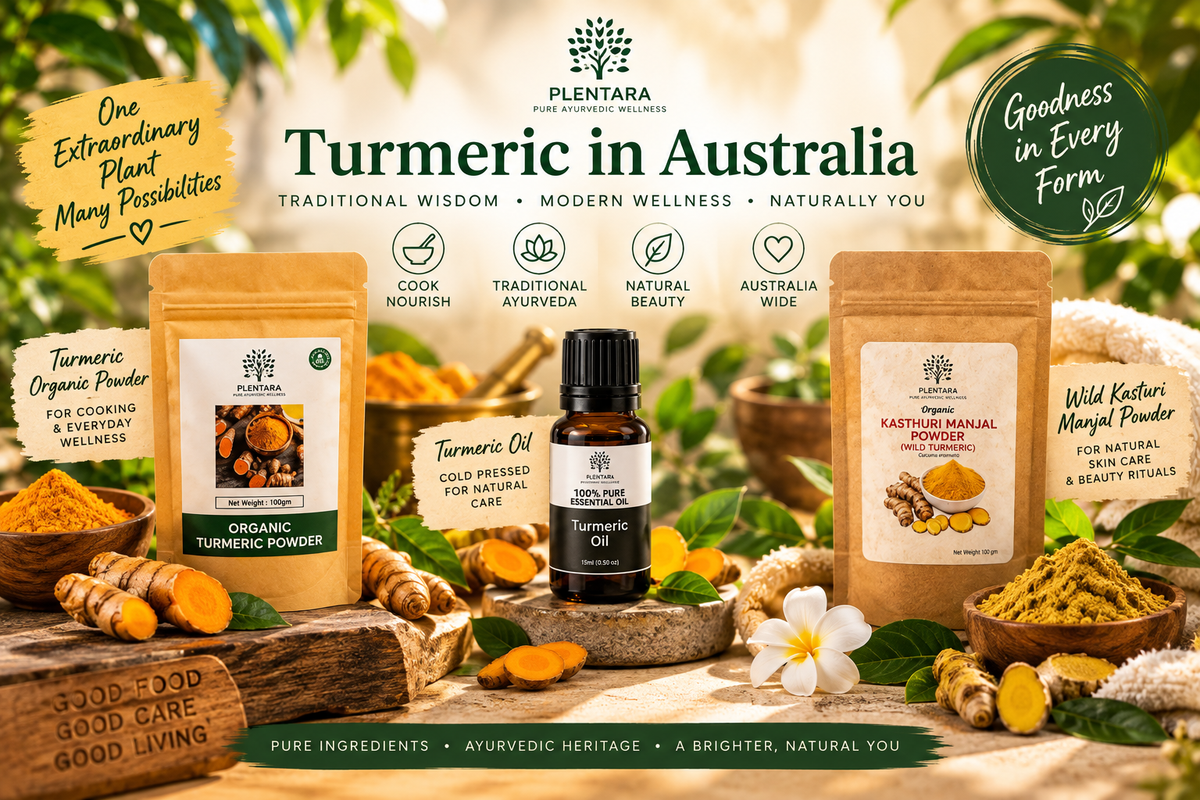
For Australians looking for organic turmeric powder, Plentara offers:
Turmeric Organic Powder
Plentara describes this product as “Ayurveda's Golden Spice” and presents it as an organic turmeric powder.
When choosing turmeric powder, look at:
- Ingredient information
- Botanical identity
- Product type
- Intended use
- Storage instructions
- Supplier information
- Packaging
- Organic certification or claims, where applicable
🌿 Explore Plentara Turmeric Organic Powder
Turmeric Oil: Another Way to Use Turmeric
Turmeric is available in more than just powdered form. Turmeric oil is another way consumers may encounter this traditional botanical ingredient.
Plentara offers Turmeric Oil - Organic Cold Pressed, 15 ml Glass Bottle as part of its Ayurvedic cold-pressed oil range.
Because an oil and a powder are different product formats, they should not be treated as interchangeable.
A turmeric powder may be intended for culinary or other specific uses, while a turmeric oil should be used according to the specific product directions and intended application.
What to Check When Choosing Turmeric Oil
When comparing turmeric oils in Australia, look at:
- The ingredient information
- Botanical identity
- Intended use
- Application directions
- Carrier oils or other ingredients, if applicable
- Bottle size
- Storage instructions
- Supplier information
For topical products, always follow the directions supplied with the product and avoid assuming that an oil intended for external use is suitable for consumption.
🌿 Explore Plentara Turmeric Oil
Turmeric Oil - Organic Cold Pressed
What Is Curcumin?
Curcumin is not the same thing as turmeric.
This distinction is important.
Turmeric refers to the plant and its rhizome, commonly Curcuma longa.
Curcumin is one of the naturally occurring compounds found in turmeric and is associated with its characteristic yellow colour.
Think of it this way:
Turmeric = the whole botanical ingredient
Curcumin = one group of naturally occurring compounds within turmeric
This is why a culinary turmeric powder and a concentrated curcumin supplement should not automatically be treated as equivalent products.
They can differ considerably in:
- Form
- Concentration
- Intended use
- Preparation
- Product claims
- Regulatory classification
Turmeric vs Curcumin
| Turmeric | Curcumin | |
|---|---|---|
| What is it? | A botanical/spice | A naturally occurring compound in turmeric |
| Botanical source | Curcuma longa | Found in turmeric |
| Common format | Root, powder, spice, extracts | Concentrated extracts/supplements |
| Culinary use | Common | Not generally used as a normal culinary spice |
| Colour | Golden yellow | Contributes to turmeric's yellow colour |
| Product types | Food, powders, herbal products, cosmetics | Often concentrated supplement formulations |
This distinction becomes particularly important when reading online information about turmeric.
A study or claim about a concentrated curcumin extract should not automatically be interpreted as evidence about an ordinary spoonful of culinary turmeric powder.
What Is Kasturi Manjal?
Kasturi Manjal, commonly called wild turmeric, is a different Curcuma species from the turmeric most commonly used as a kitchen spice.
Plentara's product is identified as:
Wild Kasturi Manjal Powder Organic
with the botanical name Curcuma aromatica. The product is presented as an Ayurvedic face-pack product and is listed separately from Plentara's culinary-style Turmeric Organic Powder.
Kasturi Manjal has a long association with traditional Indian beauty practices.
Because Plentara's Kasturi Manjal product is presented for topical face-pack use, it should be treated differently from a turmeric product intended for culinary use.
🌿 Explore Wild Kasturi Manjal Powder Organic
Turmeric vs Kasturi Manjal
This is one of the most useful distinctions for anyone exploring Ayurvedic powders.
| Turmeric | Kasturi Manjal | |
|---|---|---|
| Botanical identity | Curcuma longa | Curcuma aromatica |
| Common association | Culinary spice and traditional use | Traditional beauty practices |
| Typical format | Powder, spice, extracts | Powder |
| Plentara product | Turmeric Organic Powder | Wild Kasturi Manjal Powder Organic |
| Intended use | Depends on product | Plentara's product is presented as a face pack |
| Colour/profile | Characteristic golden turmeric colour | Distinct wild-turmeric botanical |
The two should therefore not be treated as interchangeable products.
How Is Turmeric Used in Cooking?
Turmeric is particularly familiar as a culinary spice.
It is commonly used in South Asian cooking to contribute:
- Colour
- Earthy flavour
- Warm spice notes
- Depth to spice blends
It can be added to dishes such as:
Curries
Turmeric is a familiar ingredient in many curry and spice preparations.
Rice dishes
A small amount can provide a characteristic golden colour.
Soups
Turmeric can be incorporated into some savoury soup recipes.
Vegetable dishes
It pairs naturally with many vegetables and spice combinations.
Spice blends
Turmeric is commonly found alongside ingredients such as cumin, coriander, ginger and chilli.
Golden milk
Turmeric is also widely associated with golden-milk-style beverages.
For any food use, make sure you're using a product specifically intended and labelled for culinary consumption.
How Is Turmeric Traditionally Used in Ayurveda?
Turmeric has a long history within Ayurvedic traditions.
Traditional Ayurvedic preparations can involve turmeric in different forms, including powders and combinations with other botanical ingredients.
However, traditional Ayurvedic descriptions should be understood within their traditional context.
They should not automatically be interpreted as modern medical claims.
This distinction is particularly important in Australia, where the regulatory framework can depend partly on how a product is presented and what claims are made about it.
Turmeric for Skin and Beauty
Turmeric also appears in traditional Indian beauty practices.
However, culinary turmeric and cosmetic turmeric products should not automatically be treated as the same thing.
If a product is specifically sold for topical use, follow its directions and intended purpose.
For example, Plentara's Wild Kasturi Manjal Powder Organic is specifically presented as an Ayurvedic face-pack product.
This gives consumers a clearer distinction:
Turmeric Organic Powder
→ product intended according to its own label and directions
Wild Kasturi Manjal Powder Organic
→ topical face-pack product
Always check the individual product page before deciding how a botanical powder should be used.
How to Choose Turmeric Powder in Australia
If you're searching for turmeric powder in Australia, don't choose a product based only on its colour or the number of claims on its packaging.
Here are some useful things to check.
1. Check the botanical identity
Look for the botanical name where provided.
For common turmeric, this is generally:
Curcuma longa
2. Check the intended use
Is it:
- Food?
- Herbal preparation?
- Cosmetic?
- Supplement?
Don't assume that one turmeric product can be used for all four purposes.
3. Check the ingredient list
Look beyond the front label.
Check whether you're buying:
- Pure turmeric powder
- A turmeric blend
- Turmeric extract
- Curcumin extract
- Turmeric combined with other ingredients
4. Check the quantity
Compare package sizes when comparing prices.
5. Check storage instructions
Keep powdered products dry and sealed according to the manufacturer's instructions.
6. Check the supplier
Clear supplier information makes it easier to understand what you're buying and who is responsible for the product.
Organic Turmeric: What Should You Check?
The word organic can be useful when comparing products, but consumers should still look at the actual product information.
Consider:
- What ingredient is certified or claimed to be organic?
- Is certification information provided?
- Is the product a single ingredient?
- What is its intended use?
- Are there added ingredients?
- How is it packaged?
An organic label doesn't replace the need to read the ingredient list.
Can Turmeric and Kasturi Manjal Be Used Interchangeably?
Not necessarily.
Although both are associated with the Curcuma genus, they are different botanical materials and can have different traditional and product uses.
The most important thing is to use each product according to its specific intended purpose and directions.
For example, a product presented as a face pack should not automatically be treated as a culinary ingredient.
Likewise, a culinary turmeric product should not automatically be assumed to be formulated or intended for cosmetic use.
Turmeric and Australian Product Regulations
This is an important consideration for Australian consumers and businesses.
The regulatory status of a product can depend on several factors, including:
- Claims made about the product
- Ingredients or composition
- How the product is administered or used
- Whether it falls within an excluded category
The TGA explains that cosmetics and therapeutic goods are subject to different regulatory frameworks and that classification needs to be considered on a case-by-case basis.
For example, cosmetic products are generally intended to change appearance or odour, cleanse, maintain or protect an external part of the body. Therapeutic goods, by contrast, involve therapeutic uses such as preventing, treating or alleviating disease or modifying physiological processes.
This means the wording used to market a product matters.
A topical turmeric product described as part of a cosmetic beauty routine is different from a product promoted as treating a medical condition.
For Plentara, this distinction is particularly important because the brand sells products spanning food/spice, Ayurvedic, wellness and cosmetic categories.
TGA: Determining if your product is a cosmetic or therapeutic good
AICIS: Cosmetics and soap guidance
Turmeric Supplements Are Different From Turmeric Powder
This distinction deserves its own section because it can prevent a lot of confusion.
A packet of turmeric powder isn't automatically equivalent to a concentrated turmeric or curcumin supplement.
Supplement formulations can contain:
- Extracts
- Concentrated compounds
- Different quantities
- Other ingredients
- Formulation technologies intended to alter absorption
Healthdirect currently warns that medicines and herbal supplements containing turmeric or curcumin can, in rare cases, be associated with liver injury.
The TGA issued a safety advisory concerning medicines and herbal supplements containing Curcuma longa and/or curcumin after receiving reports of liver problems.
This warning concerns medicines and herbal supplements, not a blanket statement that ordinary culinary turmeric is dangerous.
If you're considering an oral turmeric or curcumin supplement, particularly if you have existing liver problems or take medicines, seek appropriate professional advice and check the product information.
Turmeric Powder vs Curcumin Supplements
| Turmeric powder | Curcumin supplement |
|---|---|
| Whole-ground botanical ingredient | Often a concentrated formulation |
| Commonly used as a spice | Generally positioned as a supplement |
| Culinary applications | Intended according to product label |
| Composition varies naturally | Formulation can be standardised |
| Not automatically equivalent to extract | May contain additional ingredients |
This is why online claims about "turmeric" should always be interpreted in context.
A study involving a concentrated extract doesn't automatically tell you what an ordinary culinary turmeric powder will do.
How to Store Turmeric Powder
Powdered turmeric is relatively straightforward to store.
Keep it dry
Moisture can affect powdered ingredients.
Seal the package
Keep the container or pouch properly closed after use.
Store away from excessive heat
Follow the manufacturer's recommended storage conditions.
Use clean utensils
Avoid introducing moisture or contaminants into the powder.
Check the best-before date
Follow the product's stated shelf-life information.
Frequently Asked Questions
What is turmeric?
Turmeric is a plant from the ginger family, commonly identified as Curcuma longa. Its rhizome is widely used as a culinary spice and has a long history in traditional practices.
What is turmeric powder?
Turmeric powder is a finely ground form of turmeric rhizome. Depending on the product, it may be intended for culinary, herbal or other uses.
What is the botanical name of turmeric?
Common culinary turmeric is generally identified as Curcuma longa.
Is turmeric the same as curcumin?
No. Turmeric is the botanical ingredient, while curcumin is one of the naturally occurring compounds found in turmeric.
What is Kasturi Manjal?
Kasturi Manjal, or wild turmeric, is associated with Curcuma aromatica. Plentara's Wild Kasturi Manjal Powder Organic is presented as an Ayurvedic face-pack product.
Is Kasturi Manjal the same as normal turmeric?
No. They are different Curcuma species and should not automatically be treated as interchangeable products.
What is turmeric traditionally used for in Ayurveda?
Turmeric has a long history within Ayurvedic traditions and appears in different traditional preparations. Traditional use should be distinguished from modern clinical claims.
Can turmeric powder be used for cooking?
A turmeric product intended for food use can be used according to its food-label directions. Always check the product's intended use before consuming any powdered botanical.
Can I use culinary turmeric as a face mask?
Don't assume that a culinary product is suitable for cosmetic use. Use products according to their stated intended purpose and directions.
Where can I buy turmeric powder in Australia?
Plentara offers Turmeric Organic Powder for Australian customers. You can also explore the broader range of Ayurvedic and botanical powders available through Plentara.
Where can I buy Kasturi Manjal in Australia?
Plentara offers Wild Kasturi Manjal Powder Organic, presented as an Ayurvedic face-pack product.
Shop Wild Kasturi Manjal Powder Organic
Is turmeric safe for everyone?
Suitability depends on the particular turmeric product, its formulation and how it is used. Oral turmeric and curcumin medicines/supplements have specific safety considerations, including a rare risk of liver injury reported by Australian health authorities.
What is turmeric oil?
Turmeric oil is an oil-based product associated with turmeric and may be used in different personal-care or traditional applications depending on its formulation and intended purpose. Plentara offers an Organic Cold Pressed Turmeric Oil in a 15 ml glass bottle. Always follow the individual product's directions and intended use.
Where can I buy turmeric oil in Australia?
Plentara offers Turmeric Oil - Organic Cold Pressed, 15 ml Glass Bottle through its Ayurvedic cold-pressed oil range.
Final Thoughts
Turmeric is much more than a bright yellow spice.
From culinary turmeric powder to its long history within Ayurvedic traditions and the distinct botanical identity of Kasturi Manjal, there are several different ways consumers may encounter turmeric products.
Understanding the difference between:
Turmeric → Curcuma longa
Curcumin → a naturally occurring compound in turmeric
Kasturi Manjal → Curcuma aromatica
can make it much easier to choose the right product for your intended use.
If you're exploring turmeric powder in Australia, start with the basics: check the botanical identity, ingredient information, intended use, directions and supplier details.
And remember, a product marketed for the kitchen, a cosmetic beauty routine and an oral supplement can belong to very different categories.
🌿 Explore Plentara's Turmeric & Botanical Powders
Discover Plentara's range of turmeric and botanical products, including Turmeric Organic Powder, Turmeric Oil and Wild Kasturi Manjal Powder Organic, and explore different formats for modern routines.