Triphala in Australia: A Guide to Ayurveda's Traditional Three-Fruit Formula
Explore Triphala, the classical Ayurvedic combination of Amla, Bibhitaki and Haritaki, and discover the different powder and capsule formats available from Plentara.
Triphala is one of the best-known classical formulations associated with Ayurveda. Its name refers to a combination of three fruits: Amla, Bibhitaki and Haritaki. Rather than being a single herb, Triphala brings these three botanical ingredients together in a traditional formulation.
For Australians exploring Ayurvedic products online, Triphala can appear in several formats, including loose powder and capsules. Understanding the three ingredients, the format of the product and the directions supplied with it can make it easier to choose a product that fits your preferences.
The Three Fruits Behind Triphala
The classical Triphala combination consists of three fruits. Each has its own botanical identity and is also available individually in different Plentara products.
Amla
Also known as Indian Gooseberry or Amalaki, Amla is one of the best-known fruits associated with Ayurvedic traditions.
Explore Amla Capsules →Bibhitaki
Bibhitaki is the second fruit in the classical three-fruit Triphala combination. It is encountered primarily as part of the traditional formulation.
Found as part of Plentara's Triphala formulation.Haritaki
Haritaki is a traditional Ayurvedic fruit and one of the three ingredients associated with classical Triphala.
Explore Haritaki Capsules →Three Fruits. One Traditional Formula.
Together, these three fruits form the traditional Triphala combination.
Triphala in Traditional Ayurveda
Triphala has a long history within Ayurvedic traditions and is traditionally described as a combination of Amla, Bibhitaki and Haritaki.
Each fruit is also encountered individually in Ayurvedic preparations. This is why understanding the individual ingredients can be useful when researching Triphala.
Plentara's existing Ayurvedic capsule range includes individual Amla Capsules and Haritaki Capsules, alongside the Triphala formulation.
Triphala Powder or Capsules?
Plentara offers Triphala in two formats: an organic Triphala powder and Triphala capsules. Both contain the classical three-fruit combination, but the format and preparation experience are different.
Organic Triphala Powder
Plentara's Organic Triphala Powder is described as a 100% pure, certified organic formulation containing the traditional three fruits: Amalaki, Bibhitaki and Haritaki.
- Available in 100g and 500g
- 100% pure certified organic Triphala
- Vegan and gluten free
- No additives, preservatives or fillers
- Traditional Ayurvedic preparation
How the product directions describe its use
The supplied product information recommends mixing ½ teaspoon with warm water before bedtime, or using it as advised by an Ayurvedic practitioner. It can also be taken with honey or warm milk.
Always read the product label and follow the directions for use.
Explore Ayurvedic PowdersTriphala Capsules - 60
Plentara's Triphala Capsules are described as a traditional Ayurvedic herbal supplement made from the classical three-fruit blend: Amalaki, Bibhitaki and Haritaki.
- 60 capsules per pack
- Classical three-fruit formulation
- Amalaki / Amla
- Bibhitaki
- Haritaki
- Convenient capsule format
Directions and storage
Take as directed by your healthcare professional or according to the product label instructions.
Store in a cool, dry place away from direct sunlight and keep out of reach of children.
Explore Triphala CapsulesTriphala Powder vs Capsules
Neither format needs to be treated as universally better. They simply provide different ways of experiencing the same traditional three-fruit formulation.
| Feature | Triphala Powder | Triphala Capsules |
|---|---|---|
| Format | Loose botanical powder | Capsule format |
| Quantity | 100g and 500g | 60 capsules |
| Preparation | Mixed according to product directions | Convenient pre-formulated format |
| Ingredients | Amla, Bibhitaki and Haritaki | Amla, Bibhitaki and Haritaki |
| Product positioning | 100% pure certified organic Triphala | Traditional Ayurvedic herbal supplement |
If you prefer a format that requires preparation, the powder may fit more naturally into your routine. If portability and convenience matter more, capsules provide a straightforward alternative.
Amla: One Fruit, Several Plentara Formats
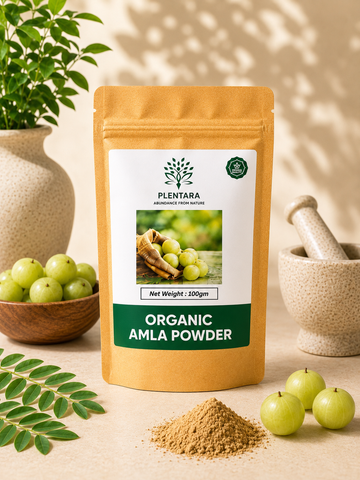
Amla, also known as Indian Gooseberry or Amalaki, is one of the three fruits in Triphala. Plentara also offers Amla independently in powder, oil and capsule formats.
Organic Amla Powder
Plentara's Organic Amla Powder is described as pure, sun-dried and certified organic, with no preservatives, additives or fillers.
- Available in 100g and 500g
- Organic Amla
- Sun-dried
- Vegan and gluten free
- No preservatives or fillers
The supplied product information describes both an internal preparation and a topical hair-mask preparation. Always follow the product label and directions.
Explore Amla & Herbal Powders →Amla Capsules - 60
Plentara's Amla Capsules are described as a single-herb Ayurvedic formulation based on Emblica officinalis.
- 60 capsules per pack
- Single-herb formulation
- Emblica officinalis
- Convenient capsule format
Organic Amla Oil
Plentara's Amla Oil is described as a traditional Ayurvedic hair oil prepared using Amla and a cold-processed base.
- 250ml
- Cold processed herbs
- No mineral oil
- Traditional Ayurvedic preparation
- Suitable for all hair types according to the supplied product information
The supplied directions describe massaging the oil into the scalp and hair, leaving it for 30–60 minutes or overnight, then washing it out with a mild shampoo.
Explore Ayurvedic Hair Oils →Haritaki: Another Traditional Triphala Fruit
Haritaki, botanically identified as Terminalia chebula, is another of Triphala's three traditional fruits. It is also available individually from Plentara in powder and capsule formats.
Organic Haritaki Powder
Plentara describes its Organic Haritaki Powder as 100% certified organic, traditionally processed and free from additives.
- Available in 100g and 500g
- 100% certified organic
- Vegan and gluten free
- No additives
- Traditionally processed
The supplied directions recommend mixing ½ teaspoon with warm water before bedtime, or using it as advised by an Ayurvedic practitioner. It can also be taken with honey or warm milk.
Explore Haritaki PowderHaritaki Capsules - 60
Plentara's Haritaki Capsules are described as a single-herb Ayurvedic formulation using Terminalia chebula.
- 60 capsules per pack
- Single-herb formulation
- Terminalia chebula
- Convenient capsule format
The product directions state that it should be taken as directed by a healthcare professional or according to the product label.
Explore Haritaki CapsulesContinue Exploring Ayurvedic Botanicals
Triphala connects naturally with several other Plentara articles and product collections. Explore the wider Ayurvedic knowledge hub below.
How to Choose Triphala in Australia
When searching for Triphala in Australia, don't rely only on the product name. Take a moment to look at the actual formulation and product information.
1. Check the three ingredients
A traditional Triphala formulation consists of Amla, Bibhitaki and Haritaki. Checking the ingredient information helps you understand exactly what you're buying.
2. Check the botanical names
Botanical names are useful when comparing herbal products because common names can sometimes vary between traditions and products.
- Amla / Amalaki — Emblica officinalis
- Bibhitaki — Terminalia bellirica
- Haritaki — Terminalia chebula
3. Choose the format that suits your routine
Powder and capsules are simply different product formats. Consider whether you prefer a loose powder that can be prepared according to its directions or a convenient capsule format.
4. Read the directions
Do not assume that every Triphala product should be used in exactly the same way. Follow the directions supplied with the individual product.
5. Look for transparent product information
A useful product listing should make it clear what the product contains, how much is supplied, how it is intended to be used and what storage instructions apply.
Triphala and Australian Product Considerations
Australian consumers should distinguish between traditional Ayurvedic descriptions and claims about modern therapeutic effects.
The Therapeutic Goods Administration states that listed medicines must be included in the Australian Register of Therapeutic Goods before supply and can only make permitted low-level indications.
The TGA also explains that websites containing information about listed medicines can form part of the product's advertising and presentation. Claims therefore need to be consistent with the applicable regulatory framework.
This is particularly relevant when writing about ingestible Ayurvedic products. Statements such as "traditionally used in Ayurveda" and a modern claim about treating a disease or condition are not equivalent.
For official Australian information, see:
- TGA: Listed medicines
- TGA: Labelling and advertising for listed medicines
- TGA: Labelling and presentation requirements
- TGA: Supporting claims and indications for listed medicines
Using Triphala Responsibly
Triphala products can differ in formulation, format and directions. Always read the individual product label before use.
Plentara's Triphala Powder information recommends reading the label and following the directions for use. It also advises people who are pregnant, breastfeeding or taking medication to speak with a healthcare practitioner before use.
The Triphala Capsules information similarly directs consumers to follow the product label or advice from a healthcare professional and to consult a health professional if symptoms persist.
If you're taking medication, pregnant or breastfeeding, managing a health condition, or uncertain whether a particular herbal product is suitable for you, speak with an appropriately qualified healthcare professional before use.
Triphala FAQs
What is Triphala?
What are the three fruits in Triphala?
Is Triphala available in Australia?
What is the difference between Triphala powder and capsules?
What is Amla's role in Triphala?
What is Haritaki's role in Triphala?
How should Triphala powder be used?
How should Triphala capsules be taken?
How should Triphala capsules be stored?
Is Triphala scientifically proven?
Can everyone use Triphala?
Keep Exploring the Plentara Journal
If you're researching traditional Ayurvedic botanicals, these guides provide useful next steps.
Discover Triphala with Plentara
Explore Triphala in powder and capsule formats, alongside individual Ayurvedic botanicals such as Amla and Haritaki.
Explore Ayurvedic SupplementsInformation note: This article is provided for general educational purposes. Traditional Ayurvedic descriptions are presented as traditional context and should not be interpreted as medical advice or as claims that a product diagnoses, treats, cures or prevents disease. Always read the current product label and follow the supplied directions. If you have questions about whether a product is appropriate for you, consult a qualified healthcare professional.